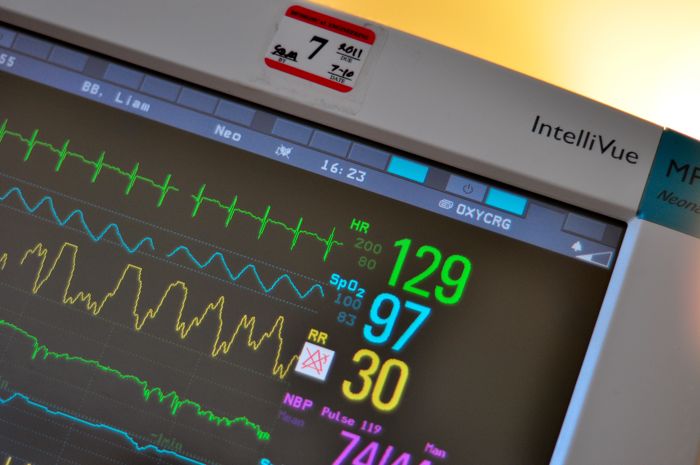
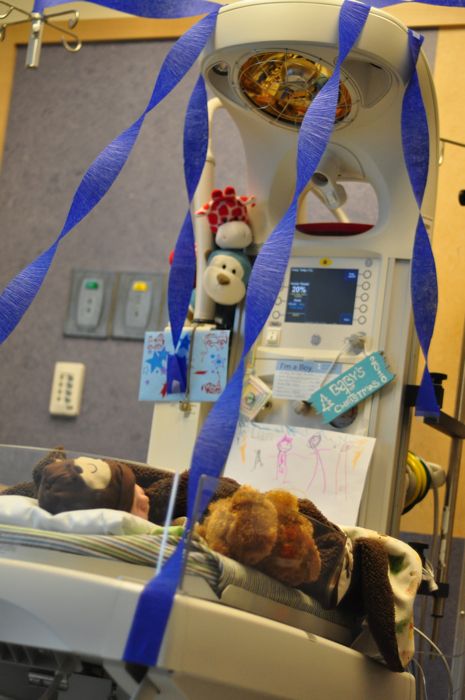
Now this is an interesting object. Not so much because of what it does – that part is simple, rather because of how much we rely on it not only to tell us what is going on, but for comfort as well. For those of you that might have missed the past two decades of overdone hospital based television dramas (or are just simply newer to the world), the monitor tells us what Liam’s heartrate is (green), what is oxygen saturation levels are (blue), and what his respiratory rate is (yellow). It also tells us – quite alarmingly – when they are not so good. The alarms on the monitor are also connected directly to the phone that our nurse carries around, so when they sound, so does her phone. That way, no matter where she might be – like tending to another patient – she instantly knows what is happening in our room. I would place money that if you hooked either Ahna or me up to a monitor ourselves, you would find an instant correlation between Liam’s alarm sounding and our pulse and breathing increasing.
The monitor is hooked to Liam through four different leads – but the discussion about those is being reserved for another short posting later. Turns out that we probably stare at the monitor the most, outside of Liam or each other. We check it obsessively and worry about it all the time. There is a saying in medicine that you should treat the patient, not the monitor – meaning that sometimes the monitor is misleading you. For example, the monitor may say that Liam’s pulse is low, but he looks fine and is breathing adequately (this happens sometimes, and is often attributed to him being a full-term baby). But even knowing that doesn’t ease the nerves when the alarm sounds about something. Things are just too fragile to easily dismiss anything that is happening – even if it proves to be only a small speed bump.
When we take him off of the monitor (baths, change of clothes, walks, etc), it’s like removing a security blanket for Ahna and I. Most of the time it isn’t a worry, but the moment that Liam starts to breath funky we long for the knowledge of what is happening. It’s a little strange to become so dependent on something like this, but we have found that we literally rest easier when we know that his vital signs are stable – and not just think that they are.































 The Life of a Little Hippie